“Every one of my knives has a soul”
»I used to literally fall in love with them, and I could hardly bear to let them go»
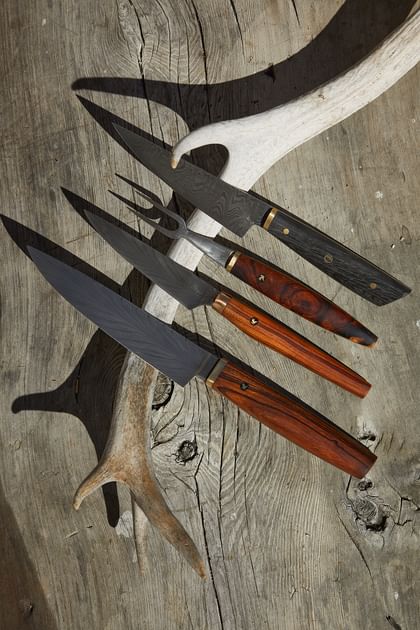
Raw steel blanks are the starting point of the renowned Damascus knives that blacksmith Roger Rominger forges in his small workshop tucked deep in the Val Fex. With their understated beauty, his creations have earned the Engadine craftsman recognition far beyond the valley. The art of knifemaking is one he taught himself.
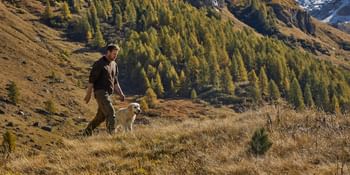
Most will associate the Val Fex, the picturesque valley branching off the central valley at Sils, with long walks, bike or horse-drawn carriage rides, and leisurely stops at one of the restaurants. Those who call it their home appreciate its peacefulness, the carfree road, and the sense of belonging that comes from being rooted in this landscape. The valley shapes its people— and Roger Rominger is one of them. His working life began on a more conventional path. The son of a farmer, he often watched the village farrier at work and one day decided to learn the trade himself. He liked the strenuous, sweaty work with glowing steel, forging and fitting hundreds of metal parts for houses and shoeing horses. «But I knew I didn't want to spend the rest of my life making railings and window grilles,» he recalls. «I wanted to push the limits of the material further, because with steel, a skilled blacksmith can make almost anything.» The house in Val Fex where Rominger lives with his wife, Martina, and their two children, is modest but full of warmth. In the evenings, he often sits outside by an open fire, pondering life and letting new ideas for future projects find him. «No two of my knives are ever the same,» he says. «Each piece tells its own story— and most of those stories begin right here in the Val Fex.» We owe it to a 2007 television documentary about a bladesmith that Rominger, now 41, became a knife-maker. Fascinated by the craft's complexity and precision, he recalls: «The idea of forging my own knives wouldn't leave me alone, but I had no idea where to start. YouTube didn't exist then, and I didn't have any books on the topic either.»
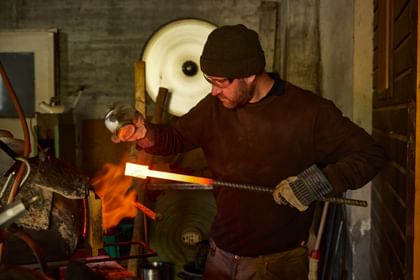
Forging a knife from raw steel blanks involves many steps. Rominger begins by stacking five thin plates of two different steel alloys—ten layers in total—into a small bundle about the size of a fist. He welds the ends together and heats the bundle in a gas furnace to around 1,100 °C. Then he begins hammering it on the anvil with a mechanical forging hammer. Blow by blow, the glowing bundle is flattened and stretched into a long plate. When the plate is about 1½ centimetres thick, Rominger cuts a notch and folds it over. Reheated and hammered again, the bundle now consists of twenty layers. The process repeats—heating, hammering, folding— until Rominger has created a billet with 300 or more layers. The finished piece is then cooled down gently to prevent the steel from becoming brittle. Rominger's workshop occupies several small rooms full of nooks and crannies in the basement of his home—it is clearly a one-man operation, not laid out to receive visitors. There is no tidy showroom with pretty glass cabinets. Still, one feels more than welcome and listens spellbound as Rominger speaks with quiet passion about his craft. Once the billet has been forged into a knife shape, it is roughly ground on a belt grinder before being placed in a specialised electric knife furnace for a series of heating and cooling cycles. Finally, the blade is brought to 820 °C and quenched in oil to harden it. From that point on, the knife must never get too hot again, or it will lose its hardness. That is why Rominger grinds the blades on a century-old wet-grindstone. The final polish is done dry by hand. Rominger goes to fetch his first, simple knife. It looks sturdy and a little rustic, bearing little resemblance to the sleek, refined beauties he crafts today. Over the years, his knives have become more sophisticated and precise; some take him up to two weeks to complete. Modest, yet proud of his accomplishment, he says, «Every one of my knives has a soul. I used to literally fall in love with them, and I could hardly bear to let them go.»
After the final polish, one decisive step gives each knife its characteristic look. The original billet was made from different steel alloys. Through repeated folding during forging, more than 300 wafer-thin layers have formed. Rominger dips the blade into an acid bath, which reacts differently with each alloy, turning some layers lighter and others darker depending on their manganese or nickel content. This reveals the distinctive pattern typical of Damascus steel. A Fex knife by Roger Rominger typically sells for around CHF 2,000. They are almost too beautiful to cook with. «I leave that entirely up to each owner,» he says, «some collectors display them in cabinets, others use them every day in the kitchen, but care for them as if they were a musical instrument.» His customers include wealthy visitors, valley locals, and collectors from around the world. Media coverage and word of mouth have made him and his knives famous far beyond the Engadine. Still, riches aren't part of the deal: each knife takes at least twenty hours of work. «We get by because my wife works full-time, and we get a bit of income off the farm and our thirty goats.» The knife is not complete without its handle. «I mostly use very hard woods,» Rominger explains. «Yew or walnut, and sometimes, the very hard desert ironwood from Arizona. » He also uses larch and other local woods. The wood blanks must dry for several years in his workshop so they won't warp once fitted. «A perfect knife needs a perfect handle— it's what makes a knife unique.» Come the evening, Roger Rominger enjoys sitting outside by the fire with friends. «Mountains, forest, and fire,» he muses. «That's all I need to be content. Here in Val Fex, I have everything I could wish for.»